
Why SM Series Busbar Insulator Are Essential Components in Electrical Switchgear

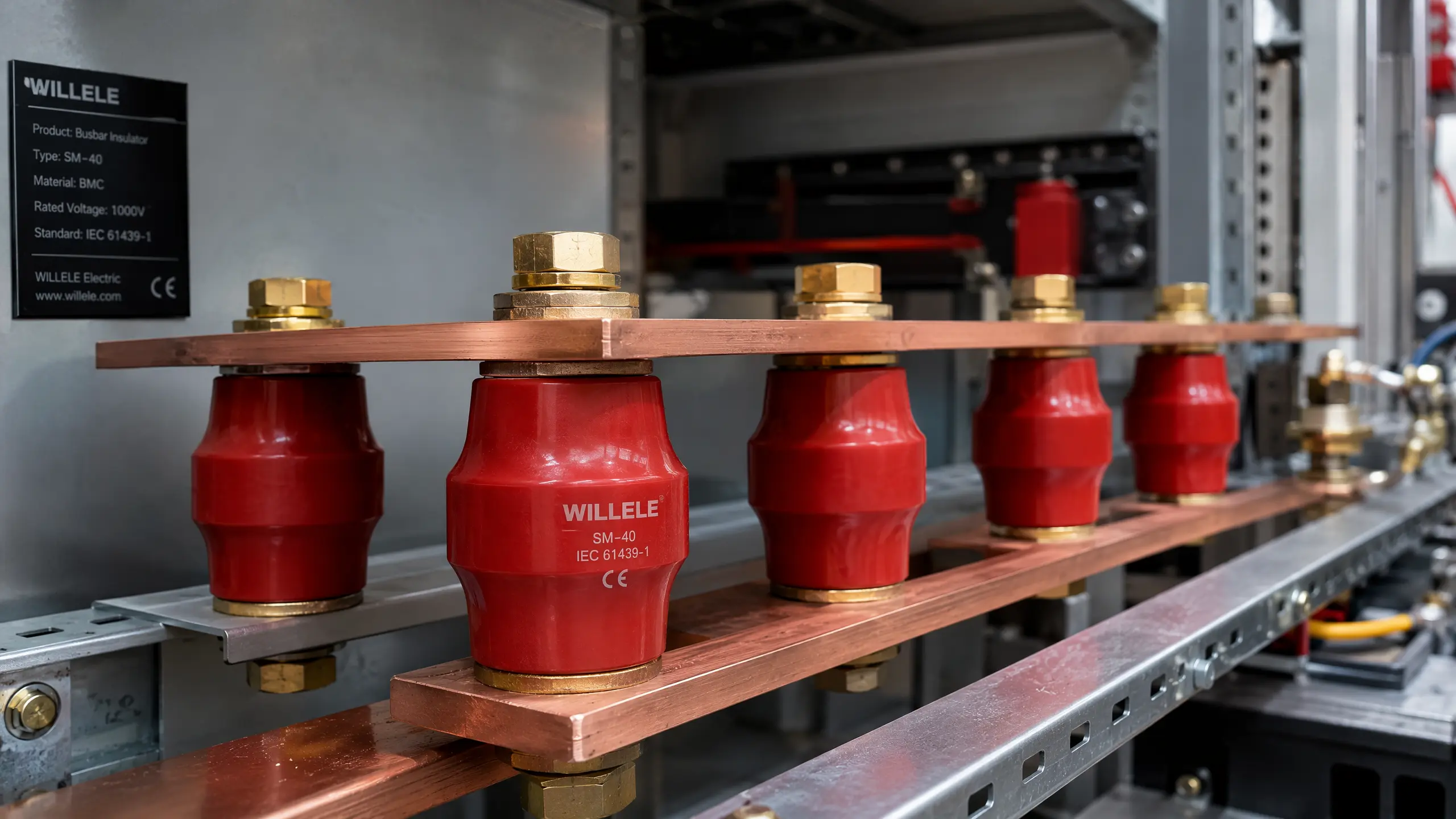
A busbar rarely fails because the copper itself gives out. It fails because whatever is holding that copper in place — and keeping it electrically isolated from everything around it — let go first. That quiet, unglamorous job belongs to the busbar insulator, and among the families of standoff insulators used across low and medium voltage equipment, the SM series has become one of the most specified shapes on the market. This article looks at what the SM series busbar insulator actually is, how it’s built, where it earns its place inside switchgear, and how to select the right model for a given panel.
What Is an SM Series Busbar Insulator?
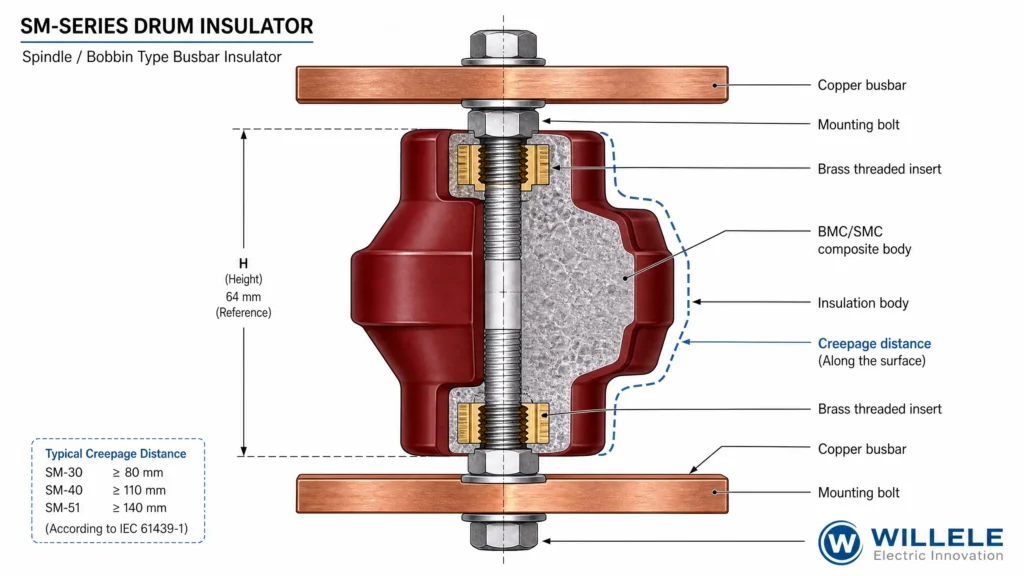
The SM series is a drum-shaped, or spindle-shaped, standoff insulator: a compact composite body with a narrower waist and two wider resting faces, each carrying a threaded female insert. That silhouette isn’t decorative — the waisted profile increases the creepage path along the insulator’s surface without adding overall height, and the flared ends give a wrench or socket a stable seat during installation. Brass or zinc-plated steel inserts are molded directly into both ends during production, so the finished part accepts an M6, M8, or M10 fastener straight out of the box, with no secondary drilling or tapping required on the panel builder’s side.
Most SM series insulators are molded from BMC (Bulk Molding Compound) or SMC (Sheet Molding Compound), fiberglass-reinforced polyester composites that have largely replaced porcelain in modern low-voltage switchgear because they mold to tighter tolerances, resist cracking under mechanical shock, and hold their shape through the thermal cycling that busbars go through as current rises and falls. Standard SM parts carry a rated voltage range spanning roughly 660V to 4,500V AC, an operating temperature window of −40°C to +140°C, and a self-extinguishing flammability rating equivalent to UL94 V-0 — the profile most low-voltage distribution equipment, inverters, and switchgear cabinets are actually built around.
Why This Component Is Essential Inside Switchgear
Open any low or medium voltage switchgear cabinet and the busbars are the most obvious thing inside it — thick copper or aluminum bars carrying the full load current between the incoming supply and every outgoing circuit. What isn’t obvious, unless something has already gone wrong, is how little clearance those bars actually have from each other and from the grounded enclosure around them. That clearance is the entire job of a busbar insulator, and it does it in three distinct ways.
First, electrical isolation. The molded composite body forms a non-conductive barrier between the live conductor and the mounting structure, and between adjacent phases where bars run in parallel. Without that barrier, or with a barrier that’s degraded, tracking or partial discharge can develop along a contaminated surface long before a full flashover occurs — which is exactly why creepage distance, not just raw dielectric strength, is the specification that actually governs safety margin in a dense panel.
Second, mechanical support. A busbar isn’t light, and it isn’t static — vibration from adjacent switching equipment, thermal expansion during load cycles, and above all the electrodynamic forces generated during a short-circuit event all try to move the bar out of position. The SM insulator’s brass insert and rigid composite core hold the bar at a fixed point and resist that movement, which is why tensile and torque ratings, not just dielectric figures, appear on every proper spec sheet.
Third, controlled clearance and creepage. IEC 61439, the standard governing low-voltage switchgear and controlgear assemblies, sets minimum clearance and creepage distances based on rated voltage and pollution degree. Choosing an insulator height and shape that satisfies those minimums — without over-sizing the panel — is a design decision the SM series makes easier, since its standard heights map directly onto the voltage classes most panels are built to.
Construction and Technical Specifications
The SM designation covers a family of sizes rather than one fixed part, distinguished mainly by drum height, which in turn drives tensile strength, torque capacity, and voltage withstand. The table below summarizes typical published values across the common SM range; always confirm exact figures for a given production lot before finalizing a drawing.
| Model | Height (mm) | Screw Thread | Tensile Strength | Torque Strength | Voltage Withstand |
|---|---|---|---|---|---|
| SM20 | 20 | M6 | ~300–500 lbs | 4–6 ft-lbs | 5 kV |
| SM25 | 25 | M6 | ~500 lbs | 6 ft-lbs | 6 kV |
| SM30 | 30 | M6/M8 | ~550 lbs | 8 ft-lbs | 8 kV |
| SM35 | 35 | M8 | ~600 lbs | 10 ft-lbs | 10 kV |
| SM40 | 40 | M8 | ~650 lbs | 12 ft-lbs | 12 kV |
| SM45/SM51 | 45–51 | M8 | ~1,000 lbs | 20 ft-lbs | 14–15 kV |
| SM60/SM65 | 60–65 | M10 | ~1,200 lbs | 35 ft-lbs | 20 kV |
| SM76 | 76 | M10 | ~1,500 lbs | 40 ft-lbs | 25 kV |
Two things stand out in that progression. Voltage withstand and tensile strength climb together, which makes sense once you consider that a taller insulator generally supports a heavier busbar spanning a longer unsupported run — the mechanical and electrical requirements aren’t independent variables, they scale with the same underlying application. And the thread size steps up in lockstep with height, from M6 on the smallest parts to M10 on the largest, so a panel’s fastener bill of materials tends to standardize naturally around three or four thread sizes rather than a dozen.
SM Series vs. Cylindrical C Series: Choosing the Right Shape
Not every switchgear layout calls for the same insulator geometry. Where the SM series’ drum shape favors compact, mid-load applications, cylindrical post-type insulators — such as the C series carried by most busbar insulator manufacturers — step up in body diameter and are built for heavier mechanical and dielectric loads. The comparison below outlines when each geometry makes more sense.
| Feature | SM Series (Drum) | C Series (Cylindrical) |
|---|---|---|
| Body shape | Drum/spindle, waisted profile | Cylindrical post, larger diameter |
| Height range | 20–76 mm | Model-dependent, larger envelope |
| Thread options | M6, M8, M10 | M6, M8, M10 depending on model |
| Typical tensile rating | 300–1,500 lbs | 500–1,500 lbs, higher on larger models |
| Typical voltage withstand | 5–25 kV | 6–22 kV, model dependent |
| Best fit | LV switchgear, distribution boxes, inverters, dense panels | LV/MV switchboards, stacked or heavy busbars, ESS/DC buses |
If a panel is space-constrained and the busbar load is moderate, the SM series’ compact drum shape and standard M6–M10 threads are usually the more economical starting point. Where the design calls for heavier bars, higher fault current withstand, or a step toward medium-voltage clearance requirements, a cylindrical post insulator with a larger body and higher tensile rating becomes the better fit. Either way, the decision should be driven by the actual busbar mass, the fault current the panel is rated to clear, and the target creepage distance — not by whichever part happens to be on the shelf.
Selecting the Right SM Model for a Switchgear Design
Specifying a busbar insulator correctly is a five-point check, and skipping any one of them is how a panel ends up with either a nuisance clearance violation on inspection or, worse, a field failure years into service.
Voltage and insulation class come first: pick a model whose withstand rating comfortably exceeds the system’s operating voltage plus any switching transients, and confirm the resulting creepage distance suits the installation’s pollution degree under IEC 61439. Mechanical load follows directly — calculate the static load from the busbar’s own weight plus the dynamic electromagnetic force expected during a short-circuit event, then choose a tensile and torque rating with real margin above that number, not just enough to pass on paper. Thread and insert selection has to match what’s already on the panel’s bill of materials; an M8 insert with inadequate depth against an over-torqued fastener is a common and entirely avoidable cause of stress cracking in the molded body. Environmental exposure changes the material call — a temperature-stable indoor panel runs fine on standard BMC, while higher humidity, UV exposure, or chemical contact in the installation environment may justify SMC or a protective coating instead. Finally, layout and clearance close the loop: use the available height options to hit the target phase-to-phase and phase-to-earth clearance without over-sizing the enclosure around it.
Applications Across Electrical Equipment
The SM series shows up wherever copper or aluminum busbars need to be held apart and held still inside an enclosure. Low-voltage switchgear and distribution boards are the most common home, where SM insulators space the incoming and outgoing bars behind circuit breakers and fused switches. Solar and battery inverters use the same drum shape to support DC bus bars running between strings and the power conversion stage, where thermal cycling and vibration are more aggressive than in a stationary distribution panel. Motor control centers, UPS systems, and ESS bus assemblies rely on the same combination of mechanical rigidity and creepage control, and EV charging infrastructure has become a growing application as DC fast-charging stations push heavier busbars through smaller enclosures than traditional distribution equipment ever required.
Manufacturing Quality and Sourcing Considerations
Because the SM series is produced by compression molding, consistency across a production run depends heavily on tooling precision and insert placement — a part with a slightly misaligned insert can still look correct on a shelf and still fail a torque or dielectric test on the bench. Buyers sourcing SM series busbar insulators for switchgear or panel-building projects should expect documented incoming, in-process, and final inspection records, along with CE, RoHS, and REACH compliance statements that project submittals typically require.
WILLELE, based in Liushi Town, Yueqing City, Zhejiang Province — a region widely known within the industry as China’s center of low-voltage electrical component manufacturing — produces its SM series and broader busbar insulator range from its own compression-molding facility. For panel builders, distributors, and EPCs sourcing internationally across Europe, North America, the Middle East, and Southeast Asia, that in-house production means engineering support that reviews an actual drawing rather than pointing back to a generic catalog page, custom heights and thread combinations when a standard size doesn’t fit the layout, and traceable production records that support compliance documentation through the project lifecycle. For a switchgear build where dimensional consistency and creepage performance can’t be left to chance, sourcing directly from the manufacturer keeps the specification, the drawing, and the delivered part aligned.
Frequently Asked Questions
What voltage range do SM series busbar insulators cover? Standard SM series parts are rated for roughly 660V to 4,500V, with individual models reaching higher kV withstand figures depending on drum height. Always confirm the exact dielectric withstand for the target voltage and pollution degree before finalizing a design.
What’s the difference between BMC and SMC SM insulators? BMC uses shorter reinforcing fibers and suits high-volume molding with tight, complex geometry; SMC uses longer fibers for higher mechanical strength, which matters more on larger drum sizes carrying heavier busbars.
Can SM series insulators be customized? Yes. Beyond the standard height steps, manufacturers commonly offer custom diameters, thread types, insert materials, and colors for project-specific requirements without a full custom-tooling cycle.
What torque should be used when installing SM insulators? Torque depends on thread size and insert material — always use the manufacturer-specified value rather than tightening by feel, since overtightening is the leading cause of stress cracking in molded insulator bodies.
How long do SM series busbar insulators last in service? Properly specified and installed BMC/SMC insulators commonly provide decades of reliable service in indoor low-voltage panels; actual lifespan depends on operating temperature, mechanical loading, and environmental exposure at the installation site.
