
Understanding Bimetal Cable Lugs (DTL Series Explained)

Understanding Bimetal Cable Lugs ?Introduction: The Anatomy of a Failure (A Story from the Field)
I’ve been a Senior Application Engineer for over fifteen years, and if there’s one lesson I’ve learned, it’s that the biggest system failures often start with the smallest components. I was once called out to a manufacturing plant where an entire production line had gone dark. The cost of downtime was ticking into the tens of thousands of dollars per hour. After hours of diagnostics, we traced the fault not to a catastrophic PLC failure or a tripped main breaker, but to a single, overheated, and ultimately melted cable lug inside a critical distribution panel.
The lug connected a large-gauge aluminum feeder cable to a copper busbar. To the untrained eye, it looked like a simple case of a loose connection. But I knew better. It was a classic case of a fundamental misunderstanding of materials science. The installer had used a standard copper lug on an aluminum cable, creating a ticking time bomb. This is a problem our industry has been wrestling with for decades. As early as the 1960s, a spike in residential fires and industrial failures was linked directly to improper terminations of aluminum wire . The root cause? The distinct physical properties of aluminum and copper.
Connecting these two dissimilar metals is not just a mechanical task; it’s an electrochemical challenge. Get it wrong, and you don’t just risk a loose connection. You risk thermal runaway, oxidation, increased resistance, and eventually, catastrophic failure. That single melted lug at the factory wasn’t a defect; it was a predictable outcome of a flawed design choice. This article is about preventing that outcome. It’s about understanding the engineered solution designed specifically for this problem: the bimetal cable lug.
The Old Debate: Copper Lugs vs. Aluminum Lugs
Before we dive into the solution, it’s critical to understand the traditional options and why they fall short when bridging the gap between aluminum and copper. For decades, engineers and installers have debated the merits of copper versus aluminum lugs, and each has its place—but also its critical limitations.
Copper Lugs are the old guard. Copper is an excellent conductor, thermally stable, and strong. For copper-to-copper connections, they are the undisputed standard. The problem arises when you try to terminate an aluminum conductor in a copper lug. Aluminum expands and contracts at a much higher rate than copper when it heats and cools under electrical load. When an aluminum cable inside a rigid copper lug expands, it deforms. When it cools and contracts, it pulls away from the lug wall, creating a micro-gap. This gap introduces air and moisture, leading to oxidation on the aluminum surface. Aluminum oxide is a poor conductor, which increases resistance, generates more heat, and accelerates the cycle of failure.
Aluminum Lugs became more common as aluminum wiring gained popularity due to its lower cost and weight. Modern aluminum lugs are not made of pure aluminum; they are typically an alloy with protective coatings . When you terminate an aluminum conductor in an aluminum lug, their similar thermal expansion rates mean they expand and contract together, maintaining a secure connection. However, you’re still left with the problem of connecting that aluminum lug to a copper busbar. This aluminum-to-copper contact point becomes the new weak link, creating a prime location for galvanic corrosion—an electrochemical reaction that degrades the metals and compromises the joint.
Here’s a simple breakdown of the trade-offs:
| Feature | Copper Lug | Modern Coated Aluminum Lug |
|---|---|---|
| Material | High-purity Copper | High-strength Aluminum Alloy |
| Conductivity | Excellent | Very Good |
| Cost | High | Low to Medium |
| Thermal Expansion | Low | High |
| Corrosion Resistance | Good (Excellent when tin-plated) | Good (when coated and used with inhibitor) |
| Best Use Case | Copper-to-Copper Connections | Aluminum-to-Aluminum Connections |
The inescapable takeaway is this: When terminating an aluminum conductor onto a copper terminal, neither an all-copper lug nor an all-aluminum lug is the correct engineering choice. You are simply moving the point of failure. The copper lug fails at the conductor, and the aluminum lug fails at the busbar.
The Hero Component: What Exactly Is a Bimetal Cable Lug?
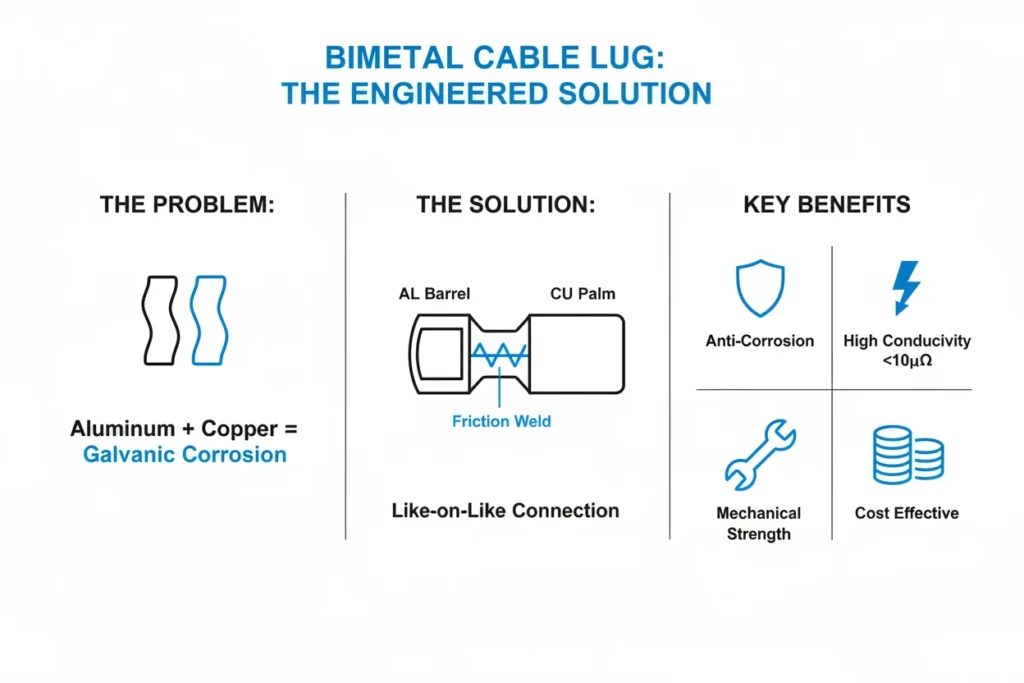
This is where the bimetal lug enters the scene, not as a compromise, but as a purpose-built solution. As defined in expert articles on the subject, a bimetal lug is a specialized connector with two distinct parts fused into one: an aluminum barrel and a copper palm .
- The Barrel: Made from high-conductivity aluminum alloy, this is where the aluminum cable is inserted. The barrel’s inner diameter is precisely matched to standard cable sizes. Crucially, the barrel is capped and pre-filled with a special antioxidant grease. This grease breaks through the thin, tough oxide layer on the aluminum conductor strands during crimping and prevents air and moisture from re-entering, stopping oxidation before it can start.
- The Palm: This is the flattened end of the lug with a bolt hole, designed to be connected to a busbar or terminal. It is made of solid, high-conductivity copper, typically tin-plated for enhanced corrosion resistance and to ensure a low-resistance connection to the copper busbar.
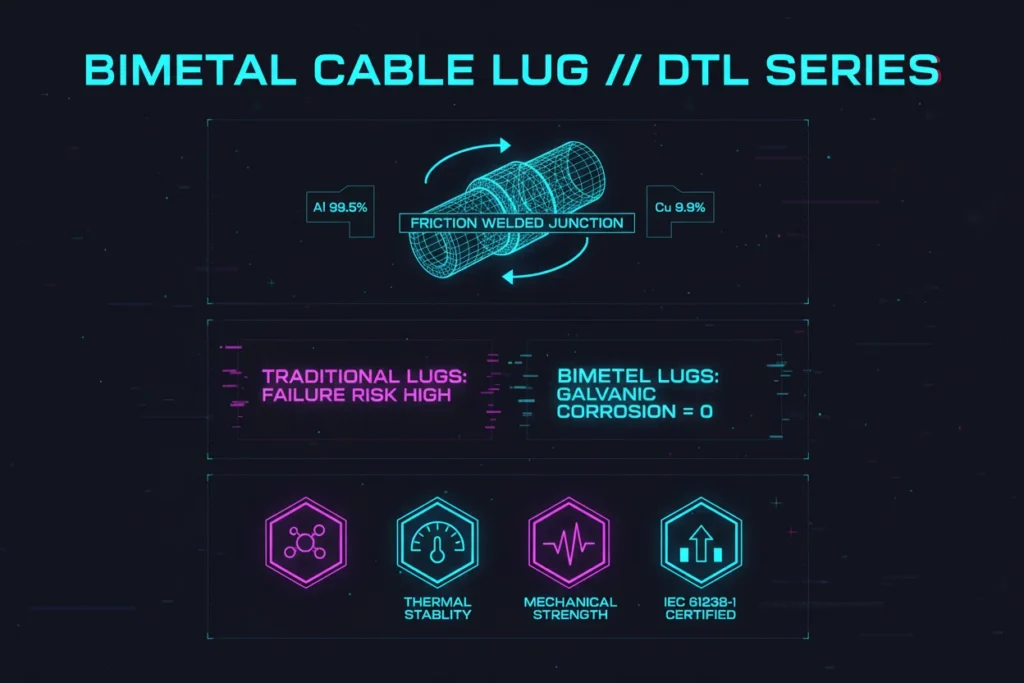
The “magic” that joins these two dissimilar metals is a process called friction welding. Imagine forcefully rotating the aluminum barrel against the solid copper palm at high speed. The intense friction generates enough heat to make the metals malleable at their interface. When they reach a plastic state, the rotation stops, and the metals are pushed together, forming a true, forged, molecular bond. It’s not glue, it’s not a screw—it’s an inseparable, full-integrity weld that is as strong and conductive as the parent metals.
This elegant design means you always have like-on-like connections at every critical point: aluminum cable in an aluminum barrel, and a copper palm on a copper busbar. The dissimilar metal junction is permanently sealed and stabilized within the friction weld. When you see designations like “DTL Series,” you are looking at a family of these industry-standard bimetal lugs, engineered to solve this very problem.
The Four Pillars of Bimetal Lug Superiority
When I’m training junior engineers, I tell them that choosing a bimetal lug isn’t about “gold-plating” a project. It’s about building in reliability from the ground up. Their superiority rests on four pillars that directly address the failure modes of traditional lugs.
Pillar 1: Eliminating Galvanic Corrosion
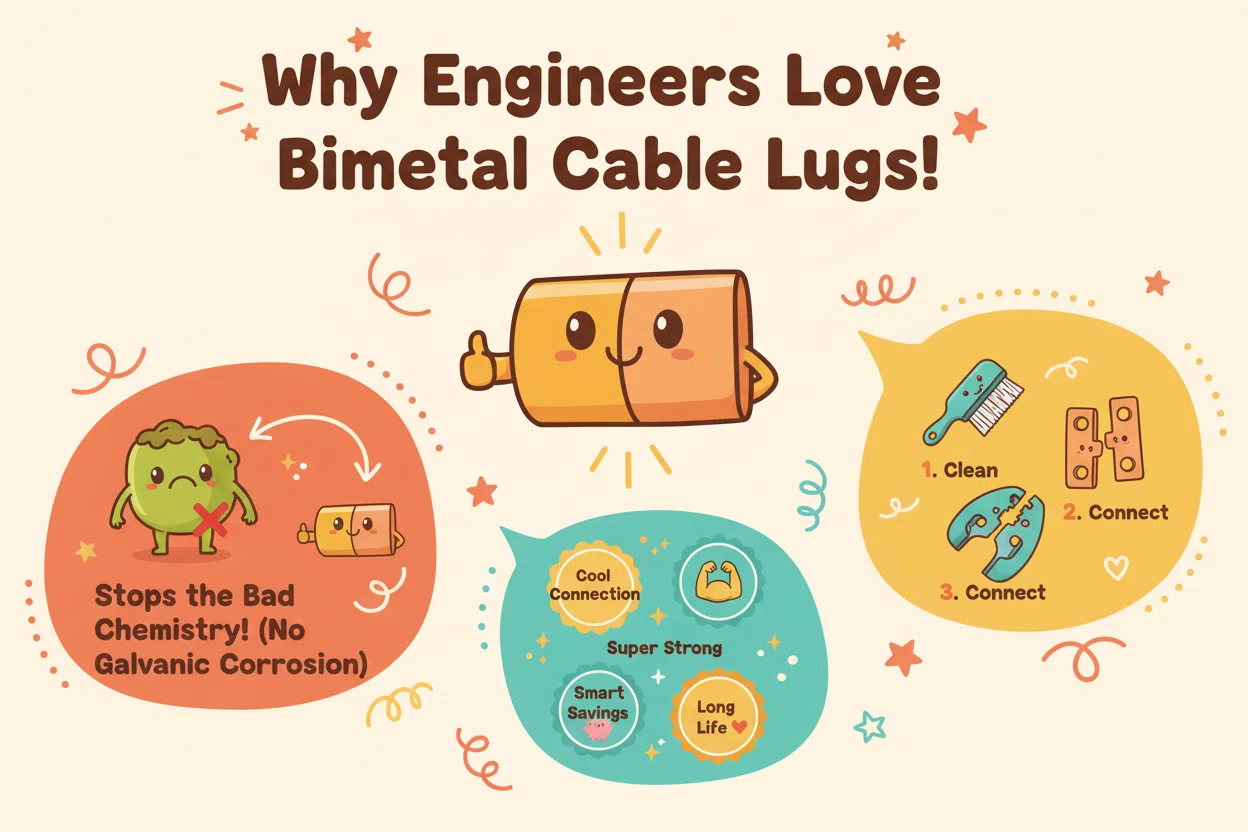
This is the number one reason to use a bimetal lug. Galvanic corrosion is an electrochemical process that occurs when two different metals are in contact in the presence of an electrolyte (like moisture in the air) . The more active metal (aluminum) corrodes, sacrificing itself to the less active metal (copper). A bimetal lug completely isolates the aluminum-to-copper junction inside the friction weld, preventing this destructive reaction from ever starting. By connecting aluminum to the aluminum barrel and the copper palm to the copper busbar, you ensure that only similar metals touch in the open environment.
Pillar 2: Ensuring Electrical and Thermal Stability
The friction weld isn’t just strong; it’s also highly conductive. Reputable manufacturers produce bimetal lugs with a joint resistance of less than 10 micro-ohms, which is well within stringent industry standards like IEC 61238-1 . This means there’s virtually no “speed bump” for the electrical current, preventing heat buildup at the junction. Furthermore, because the aluminum barrel encases the aluminum conductor, they expand and contract together under load. This prevents the loosening and micro-arcing that plagues copper lugs used on aluminum wire, ensuring a stable, low-resistance connection for the life of the system. A cool connection is a safe and efficient connection.
Pillar 3: Unyielding Mechanical Strength
That factory failure I mentioned? It wasn’t just an electrical failure; it was a mechanical one. The joint simply gave way. The friction weld on a quality bimetal lug is incredibly robust. During manufacturing tensile tests, the cable conductor itself will typically break before the weld does. This immense mechanical strength is critical in applications with high vibration (like in automotive or industrial machinery) or where conductors are subject to physical stress. The termination point should never be the weakest link in the chain, and with a properly installed bimetal lug, it won’t be.
Pillar 4: Smart Economics
Copper is expensive, and its price is volatile. Aluminum is significantly lighter and more affordable, making it the conductor of choice for large feeder cables. Bimetal lugs allow you to leverage the cost savings of aluminum conductors without compromising the safety and integrity of the connection to standard copper switchgear. While a single bimetal lug is more expensive than a standard aluminum lug, its cost is negligible when factored into the total project cost and the immense financial risk of downtime and repairs. Using bimetal lugs isn’t a cost; it’s an investment in reliability and a hedge against future failure.
A Field Guide: How to Select the Right DTL Bimetal Lug
Choosing the right lug is just as important as deciding to use one in the first place. A mis-sized or improperly specified lug is a failure waiting to happen. As an engineer, I follow a systematic process to ensure the perfect fit for every application.
Step 1: Know Your Conductor
This is the absolute starting point. You need two pieces of information:
- Material: Is it aluminum or copper? Bimetal lugs are for aluminum conductors.
- Cross-Sectional Area: This is the size of the cable, typically given in square millimeters (mm²) or American Wire Gauge (AWG). This number determines the barrel size of the lug. Each bimetal lug is stamped with the cable size it’s designed for. Never try to use a lug on a cable size it wasn’t designed for. A loose fit is a fire hazard, and a tight fit can damage the conductor strands.
Step 2: Match the Palm to the Terminal
The copper palm of the lug must match the connection point on your equipment.
- Bolt Hole Diameter: The hole in the palm must match the size of the bolt or stud on your busbar, circuit breaker, or contactor. Common sizes range from M6 to M16 or more. Using a hole that’s too big creates a poor contact surface and can lead to loosening.
- Palm Width: In tight spaces like distribution panels, ensure the palm width doesn’t interfere with adjacent lugs or phase barriers.
Step 3: Consider the Application Environment
The environment dictates the level of durability required. Bimetal lugs are used across a vast range of industries for a reason—they are versatile and robust.
- Power Transmission & Distribution: In substations and overhead lines, lugs are exposed to the elements. The robust nature of the friction weld and the pre-filled antioxidant grease are essential for long-term reliability .
- Renewable Energy: Solar and wind installations often involve long runs of large-gauge aluminum cable connecting to copper-based inverters and switchgear. The efficiency losses from a poor connection are unacceptable, making bimetal lugs the standard.
- Marine Industry: The high-salt, high-humidity environment on a ship or offshore platform is hyper-corrosive. The corrosion resistance of a bimetal lug is not a luxury here; it is an absolute necessity for safety and operational integrity.
- Industrial & Automotive: High vibration, extreme temperatures, and the need for absolute reliability make bimetal lugs a key component in everything from industrial motors to automotive battery connections.
Step 4: Understand the DTL Series (DTL-1 vs. DTL-2)
You will often see the designations DTL-1 and DTL-2. While they look similar, there’s a key difference:
- DTL-1: This is the standard type, suitable for most industrial and commercial applications. It has one bolt hole in the palm.
- DTL-2: This type features a longer palm with two bolt holes. It is specified for applications where higher mechanical security is needed to prevent the lug from twisting or rotating, especially under high vibration or on heavy-gauge cables. Always use DTL-2 lugs if the equipment terminal is designed with two studs.
By following these four steps, you move from a generic “I need a lug” to a precise specification: “I need a DTL-1 bimetal lug for a 240mm² aluminum cable with an M12 bolt hole for a switchgear application.” That level of precision is the hallmark of a professional.
Installation Done Right: A Senior Engineer’s No-Fail Checklist
A perfect lug can be ruined by a poor installation. I have seen more failures from improper crimping and preparation than from faulty products. Over the years, I’ve developed a mental checklist that I run through for every single termination. This isn’t just about following the manual; it’s about craftsmanship.
- Check Your Materials. Before you start, have the right lug and the right cable. Double-check that the cable size on the lug barrel matches the cable you’re working with. A simple check here can save you from having to redo the work.
- Prepare the Conductor. Strip the cable insulation to the correct length. The conductor strands should be fully visible and long enough to insert completely into the barrel, but no longer. Inspect the strands for any nicks or cuts from the stripping tool. Crucially, use a wire brush to vigorously clean the exposed aluminum conductor. This removes the invisible, tough layer of aluminum oxide, ensuring a clean metal-to-metal contact inside the barrel.
- Insert with Confidence. The lug’s barrel is already filled with an antioxidant compound. When you insert the cleaned conductor into the barrel, do so with a firm, slightly twisting motion. This ensures the grease fully coats all the strands and that the conductor is seated all the way to the bottom of the barrel. You should see a small amount of grease ooze out, confirming a full insertion.
- CRIMP. IT. RIGHT. This is where most mistakes happen.
- Use the Right Tool: Use a hydraulic crimping tool. Manual pliers will not provide the necessary, uniform pressure for large lugs.
- Use the Right Dies: The crimping tool uses hexagonal dies that are matched to the lug size. The size is stamped on the die. Using the wrong die set will result in an under-crimped (loose) or over-crimped (damaged) connection.
- Crimp in the Right Place: Crimp on the solid part of the barrel, never on the cap. For longer barrels, you will perform multiple crimps, starting from the palm end and working your way toward the cable end. This pushes air out and ensures maximum compaction.
- Clean and Secure the Palm. After crimping, wipe off any excess grease from the lug body and palm. The copper palm surface should be clean before you bolt it to the busbar. When tightening the bolt, use a torque wrench to apply the exact torque specified by the equipment manufacturer. Do not overtighten. Over-torquing can stretch the bolt, reducing its clamping force and leading to a loose connection over time.
- Leave It Alone. This might be the most surprising advice. Unlike old maintenance procedures, modern, properly installed terminations should not be re-torqued periodically. As one study notes, manufacturers now recommend leaving the connection alone for life, unless a thermal scan shows a developing hot spot . Re-torquing can disturb a stable connection and do more harm than good.
From the Engineer’s Mailbag: Answering Your FAQs
I get a lot of questions from engineers and technicians in the field. Here are some of the most common ones that come across my desk.
Q: Why do we really need to use bimetallic lugs? Can’t I just use a standard aluminum lug and be careful?
A: You’re only solving half the problem. While an aluminum lug is correct for the aluminum cable, you create a new problem where the aluminum palm connects to the copper busbar. That junction is now exposed to air and moisture, making it a prime site for galvanic corrosion, which will degrade the connection over time. The bimetal lug is the only solution that ensures a stable, like-on-like connection at every external interface.
Q: What is that thick grease inside the lug’s barrel?
A: That is a specially formulated antioxidant compound. It has two jobs. First, it contains hard, conductive particles (like zinc) that bite through the tough, non-conductive aluminum oxide layer on the conductor strands during the pressure of crimping. Second, it seals the connection from air and moisture, preventing that oxide layer from re-forming. It is absolutely essential for a long-lasting, low-resistance connection.
Q: Can I use a bimetal lug for a copper-to-copper connection?
A: No, you should not. Bimetal lugs are specifically designed for terminating aluminum conductors. The aluminum barrel is not intended for use with copper cables. For a copper-to-copper connection, always use a standard, high-conductivity tin-plated copper lug. Using the right component is always the best practice.
Q: What is the real-world difference between a DTL-1 (one-hole) and DTL-2 (two-hole) lug?
A: The difference is mechanical stability. A DTL-2 lug with two bolts provides superior protection against twisting and vibration. You should use a DTL-2 whenever the equipment terminal provides two studs, or in applications with significant vibration, such as on large transformers, generators, or heavy industrial machinery. The two bolts distribute the clamping force and ensure the lug cannot rotate and loosen over time.
Conclusion: Building a Foundation of Reliability
In our industry, reliability is everything. The systems we design and build power hospitals, data centers, and critical infrastructure. The integrity of these systems often comes down to the thousands of individual connections that hold them together. That single melted lug I saw years ago wasn’t just a component failure; it was a process failure—a failure to choose the right technology for the task.
The bimetal cable lug is more than just a connector. It is a precisely engineered solution to a fundamental challenge in electrical engineering. It solves the problem of thermal mismatch, eliminates the risk of galvanic corrosion, and provides a mechanically robust and electrically stable termination that will last for decades.
So the next time you are specifying a connection between an aluminum conductor and a copper terminal, remember the story of the failed lug. Don’t compromise. Choosing a quality, correctly installed bimetal lug is one of the simplest and most effective decisions you can make to build a foundation of true, long-term system reliability. It’s the professional choice, and it’s the right choice.
